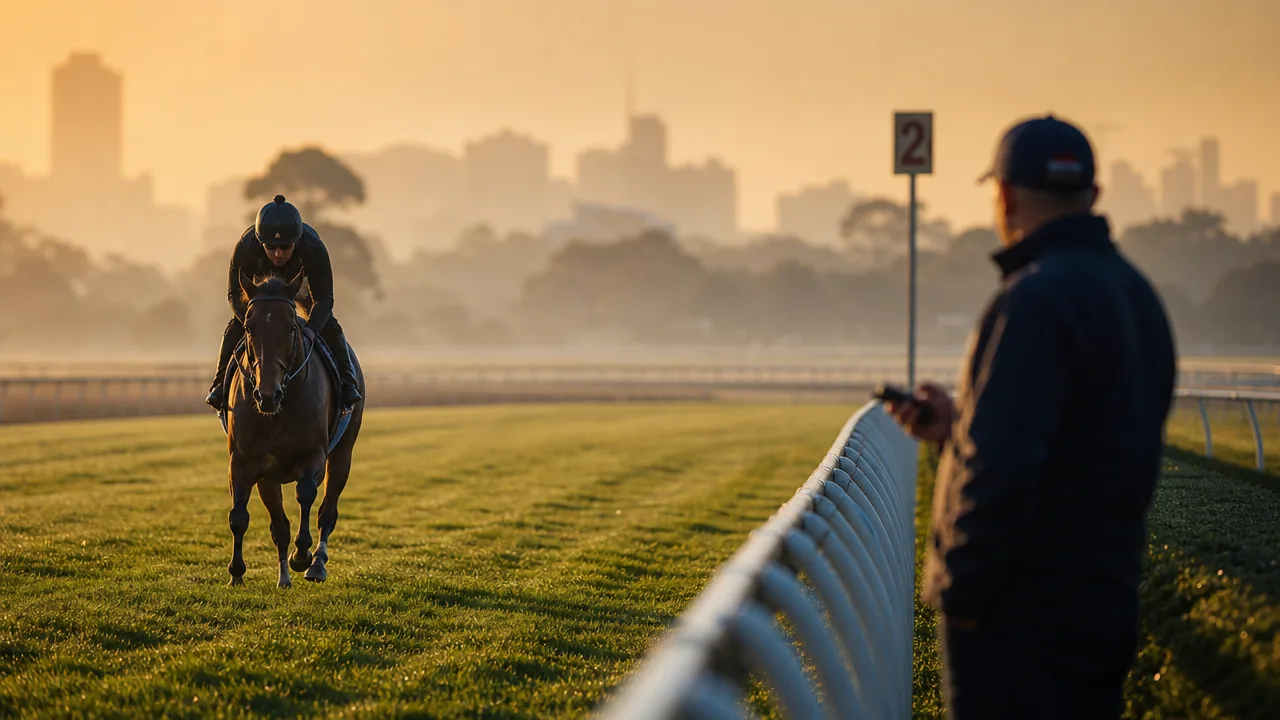
Six Strategies for the Spring Carnival
The Melbourne Spring Racing Carnival rewards preparation. These are the approaches that consistently find value — whether you're betting the Melbourne Cup or every race across seven weeks.
Strategy 01
Shop for the Best Odds
The single highest-impact habit any punter can develop.
Australian bookmakers are legally required to advertise their odds, which creates genuine price differences across the market. On a major carnival race like the Melbourne Cup, the difference between the best and worst price on a single horse can be 20–30%.
Consider a horse priced at $8.00 with Sportsbet and $10.00 with Ladbrokes on a $100 bet. The Ladbrokes bet returns $1,000 versus $800 — a $200 difference for the same selection on the same race. Over a full carnival season across seven major races, consistently finding the best price can be worth hundreds of dollars.
The discipline is simple: open accounts with at least three bookmakers (Sportsbet, TAB, Ladbrokes, and Neds cover most of the market), check all of them before placing, and always take the best available price. Best Odds Guaranteed promotions — offered by most major bookmakers on the Melbourne Cup — also mean you get the starting price if it's higher than your taken price.
How to Apply It
- Open accounts with at least 3–4 bookmakers before the carnival starts
- Check odds 30–60 minutes before race time when markets have stabilised
- Use Best Odds Guaranteed promotions — most major bookmakers offer this on Cup Day
- Fixed odds lock in your price; tote dividends fluctuate until the jump — know which you're getting
- Bonus bets and promotions compound the advantage — use them on races where you have conviction
Strategy 02
Each-Way Betting
Two bets in one — structured risk management for longer-priced horses.
An each-way bet splits your stake equally between a win bet and a place bet. If your horse wins, both parts pay out. If it runs a place (finishes in the top 3 in most races, or top 4 in fields of 16+), only the place component pays — typically at ¼ of the win odds.
The Melbourne Cup's 24-horse field makes it one of the best each-way races of the year. With top-4 place terms, a horse at $20 each-way returns a place dividend of $5.00 — meaning a $10 each-way bet ($20 total) returns $50 if your horse runs fourth. Over a race where the favourite wins at $5, the punter who backed a $20 place finisher each-way still profits.
Each-way betting is most valuable on horses priced between $8 and $30. Below $8, the place component offers limited value relative to backing it to win outright. Above $30, the place terms rarely justify the double outlay — a small each-way on genuine longshots in the Cup can be the exception.
How to Apply It
- Each-way is best on horses $8–$30 in large fields (12+ runners)
- In 16+ runner fields, confirm top-4 place terms before placing — not all bookmakers offer this automatically
- For the Melbourne Cup's 24 runners, each-way provides meaningful each-way insurance
- Avoid each-way on short-priced horses ($2–$5) — back them to win only
- Compare place terms across bookmakers — some offer 5 places on the Melbourne Cup as a promotion
Strategy 03
Lightly Weighted Internationals
The Melbourne Cup handicapper's systematic bias that savvy punters exploit.
The Melbourne Cup is a handicap race, meaning each horse carries a weight assigned by Racing Victoria's handicapper to theoretically equalise their winning chances. The system creates a structural advantage for horses the handicapper has less information about — chiefly international raiders.
Horses trained in Ireland, the UK, France, and Germany often arrive with limited Australian form. The handicapper must assign a weight based on overseas performances, which are harder to benchmark against local horses. The result is that internationals frequently receive lighter weights than their true ability warrants.
The evidence is compelling: since 2010, horses trained outside Australia and New Zealand have won the Melbourne Cup eight times. Irish trainer Joseph O'Brien has trained two Melbourne Cup winners from small fields of runners. Willie Mullins, Charlie Appleby, and Aidan O'Brien have all prepared Cup runners in recent years. A lightly-weighted international with proven 3000m+ form and an experienced jockey booking is one of the most reliable Cup angles.
How to Apply It
- Focus on internationals carrying 54kg or less — these are the "lightly-weighted" end of the field
- Prioritise horses with proven form over 3000m+ — many European stayers excel at the 3200m trip
- Check the jockey booking — a top-tier rider (Ryan Moore, Christophe Soumillon) accepting the ride is a strong signal
- Stables with a history of targeting the Cup (O'Brien, Mullins, Appleby) run focused campaigns — follow their October lead-up performances closely
- Look for internationals that ran in the Caulfield Cup — arriving fit and acclimatised with local form is the ideal preparation
Strategy 04
Market Movers
Following informed money — how to read what the smart punters know.
Horse racing markets are among the most efficient in the world because a large portion of the money wagered comes from people with genuine information advantages — owners, trainers, stable staff, and professional gamblers. When these participants bet, it moves the market.
A horse that shortens from $15 to $8 in the 72 hours before a race has received heavy support from somewhere. That support almost never comes from casual punters — retail money rarely shifts a price that dramatically. It comes from the stable or well-connected investors who have reason to believe the horse is at its peak.
The reverse is equally informative. A horse that drifts from $5 to $9 in the market (lengthens without reason) is often doing so because insiders know something is wrong — the horse isn't travelling well, has picked up a niggle in training, or the jockey has made a mental booking elsewhere. Drifting horses in carnival races deserve serious scrutiny before backing.
How to Apply It
- Check odds on Monday–Wednesday before a Saturday carnival race to establish a baseline
- A horse shortening 30%+ from its opening price in the 48 hours before a race is a significant move
- Drifters deserve caution — lengthening odds often reflect stable or insider concern
- Cross-reference market moves with scratchings — a field reduction can cause mechanical price changes that aren't meaningful
- The biggest moves on Melbourne Cup week typically happen Thursday–Friday; set a price alert on your preferred bookmaker app
Strategy 05
Lead-Up Form
The preparation pathway that historically produces Melbourne Cup winners.
Horses rarely win the Melbourne Cup fresh. The race is 3200m — a genuinely demanding distance — and horses need to arrive at their physical and mental peak, which requires race fitness. The optimal preparation for the Melbourne Cup involves two or three runs during the carnival, building to a peak on the first Tuesday in November.
The Caulfield Cup (run three weeks before the Melbourne Cup) is the premier lead-up race. Since 1990, over a third of Melbourne Cup winners have run in the Caulfield Cup as their final lead-up. Winning the Caulfield Cup also provides ballot exemption, guaranteeing entry. Horses that run second or third in the Caulfield Cup, particularly if they carried more weight than the winner, are often better bets in the Melbourne Cup than the Caulfield Cup winner itself.
The Cox Plate, held just 10 days before the Melbourne Cup, is generally too tight a turnaround for a Cup preparation — the two races rarely fall to the same horse in the same season. Derby Day (the Saturday before the Cup) has produced a handful of Cup winners over 2500m, but it's a significant undertaking to back up four days later over an extra 700m.
How to Apply It
- Prioritise horses with the Caulfield Cup (3 weeks prior) as their lead-up — the most proven pathway
- Horses racing for the first time since August or September rarely peak on Cup Day — race fitness matters at 3200m
- A Caulfield Cup runner-up or third who carried top weight often has more upside than the winner for the Melbourne Cup
- Watch trackwork in the week of the race — videos are published by Racing Victoria; a horse working strongly on Flemington grass is a positive sign
- Three-year-olds generally improve with racing and often receive lenient weights — recent editions have seen 3-year-olds run very well at good odds
Strategy 06
Manage Your Bankroll
The discipline that separates long-term punters from short-term gamblers.
The spring carnival runs across seven weeks and seven Group 1 races. Without a bankroll plan, it's easy to bet heavily on the early races, suffer a losing run, and arrive at Melbourne Cup week with nothing left to bet — or worse, chasing losses with stakes you can't afford.
Flat-stake betting is the simplest and most effective approach for recreational punters: decide on a set amount per bet (say, $20–$50) and stick to it across every race regardless of how confident you feel. This prevents the psychological trap of over-betting on "bankers" that lose and under-betting on value bets that win.
Dividing your carnival budget into units gives structure. If your carnival budget is $200, split it into 10 units of $20 — one for each major race plus a reserve for multis or value opportunties. You can watch seven weeks of great racing, have real money on every race, and walk away knowing exactly what you risked and why.
How to Apply It
- Set a carnival budget before race one and treat it as entertainment spending — money you're comfortable losing
- Flat stakes protect you from over-betting on favourites and under-betting on value longshots
- Never chase a losing bet with a larger stake — the next race is always a fresh opportunity
- Keep a simple record of your bets (horse, race, stake, odds, result) — it reveals your actual strengths and weaknesses as a punter
- For help with gambling, contact Gambling Help Online at gamblinghelponline.org.au or call 1800 858 858
Put the strategies to work
18+ only. Always gamble responsibly. For help visit Gambling Help Online or call 1800 858 858.